
PERFORMANCE
Position accuracy and operation recognition you can measure
Accurate positions and automatic event capture help keep yard records aligned with physical operations.
CHALLENGES
Yard records need reliable data from the equipment
Position reporting, lift checks and event recording all affect the reliability of yard data.
Positions are hard to verify
Manual reports can lag behind equipment movements, leaving planners without a reliable view of actual container locations.
Lift details depend on people
Single or double containers and mixed 20/40/45 ft operations require repeated checks when sensing is unavailable.
Operations lack a complete record
Without linked equipment, time, position and event records, exceptions are difficult to reconstruct.
CORE CAPABILITIES
Capture positions, container details and handling events
RTK positioning and complementary sensors capture the data needed to verify each handling operation.
RTK positioning
Capture the live position of each empty container handler using RTK corrections, with a configurable reporting interval.
Bay / row / tier identification
Combine position, height measurements and the yard layout to determine the working slot and stacking tier.
Single / double container detection
Ultrasonic sensors S1 and S2 detect container presence and distinguish one container from two stacked containers.
20 / 40 / 45 ft size recognition
Laser sensor S3 measures spreader extension to identify container size, using thresholds calibrated for the spreader model.
Pick / place event detection
Changes in S1 detection status identify picking and placing. Events are linked to timestamps and RTK coordinates.
Standard system interfaces
HTTP, WebSocket and MQTT interfaces connect operational data with YMS, TOS, tallying and digital twin systems.
SENSOR LAYOUT
Spreader sensing and mast-mounted RTK positioning
The sensor column combines ultrasonic and laser measurements. Independent positioning and power support equipment installation.
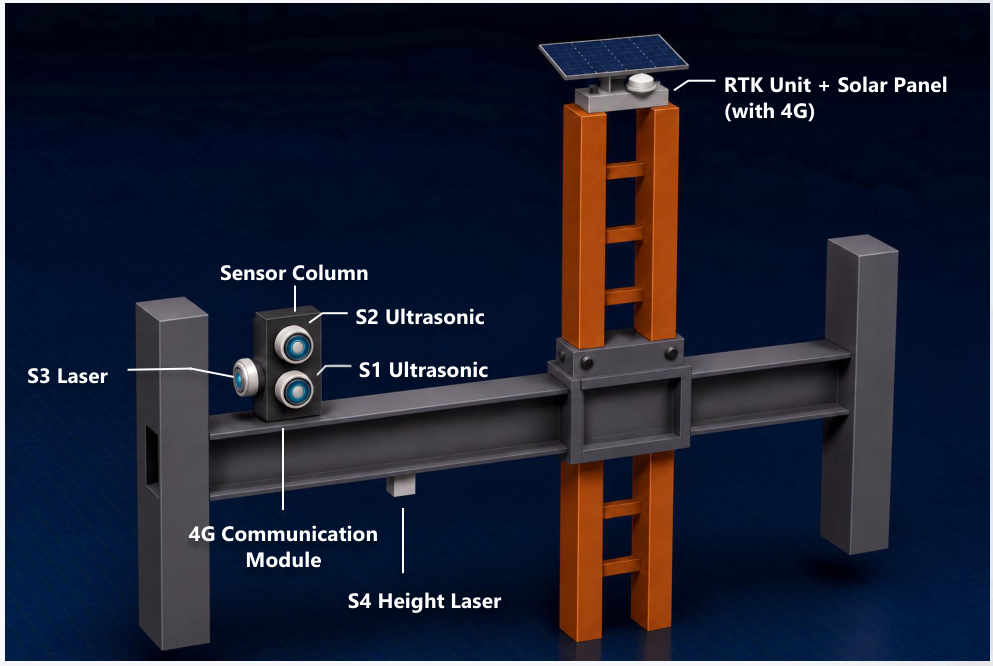
S1 / S2 ultrasonic sensors
S1 detects container presence; S2 identifies the second container during double-container handling.
S3 / S4 laser sensors
S3 measures spreader extension for size recognition. S4 measures height above ground to determine the tier.
RTK and power supply
The mast-mounted RTK unit uses solar power and a lithium battery. The spreader sensor assembly uses a 24 V supply, with an independent 4G uplink for each unit.
SYSTEM ARCHITECTURE
A continuous data path from equipment to yard systems
Independent 4G links transmit sensor and RTK data to the IoT platform. Server-side processing produces records for connected business applications.
Equipment sensing
Spreader sensors + RTK
Dual 4G uplinks
Independent sensor and positioning links
IoT platform
Data ingestion and forwarding
Server-side recognition
Container count, size, tier and pick/place
Business applications
YMS / TOS / tallying / digital twins
RTK correction services support positioning. Operation recognition and event recording run on the server.
TECHNICAL SPECIFICATIONS
Positioning, sensing and installation specifications
| Parameter | Specification |
|---|---|
| Horizontal positioning accuracy | ±10 cm |
| Vertical positioning accuracy | ±30 cm |
| RTK reporting frequency | Configurable; 1 Hz by default |
| Operation recognition accuracy | ≥98% (single/double containers, size, pick/place and tier) |
| Sensor configuration | 2 ultrasonic sensors + 2 laser sensors + 1 RTK unit |
| Communication | Dual 4G links: one for the spreader, one for RTK |
| System interfaces | HTTP / WebSocket / MQTT |
| Ingress protection | IP65 |
| Operating temperature | −20°C to +60°C |
| Power supply | RTK: solar + lithium battery; spreader sensors: 24 V |
| Mounting | Magnetic mounting + composite vibration damping |
CUSTOMER VALUE
Reliable field data for yard operations
Position and event records give planners and tallying teams a shared basis for operational checks.
Verify actual container locations
Associate RTK positions and tier detection with yard slots to check where handling actually takes place.
Reduce manual tallying
Capture container count, size and pick/place events automatically, reducing repeated checks and manual data entry.
Trace the handling process
Link equipment, time, position and action for exception review and reconciliation with yard or terminal operating systems.
Connect equipment data with your yard systems
Discuss equipment models, spreader configurations, yard layouts and system interfaces to define your APEX-SRMS installation and integration scope.